The Case for Slow Growth: Why Your Small Church isn't a Failure
In addition to being a pastor and making Congregation Hub, I work as a developer for a retail chain called Rural King (which just so happens to be headquartered two miles from my house.) Last week, we had our annual managers meeting and as part of that, our owner laid out a roadmap for how we would get from 150 stores to 1000 stores in the next fourteen years.
 As impossible as that sounds, they actually have a formula that makes a lot of sense. They try to grow 15% year over year. That 15% compounds, and wouldn't you know it? It turns 150 into 1000 by 2040.
He said that they had tried to grow faster than that in the past and it created all kinds of problems and what they have learned is that for them 15% is the sweet spot. A growth rate the company can handle.
As impossible as that sounds, they actually have a formula that makes a lot of sense. They try to grow 15% year over year. That 15% compounds, and wouldn't you know it? It turns 150 into 1000 by 2040.
He said that they had tried to grow faster than that in the past and it created all kinds of problems and what they have learned is that for them 15% is the sweet spot. A growth rate the company can handle.
I've been thinking about that for the last week and I want to apply this concept to church growth. Before I get into that, let's dispense with the obvious caveats:
- I know that God grows the church.
- I know that the church in Acts grew exponentially in a very short time.
- When God chooses to grow a church through salvation, now matter the time scale, that is a very good thing.
- We should want to see as many people come to Christ and join His church as possible as quickly as possible. With those caveats out of the way, can we think together for a few moments about how a slow annual growth rate can be a healthy way for an established church to think about growth?
I'll use my church as an example. When I first came here nearly 15 years ago, we probably averaged 50 people on Sunday mornings. Today we average around 95.
In those early years, every time a visitor walked in the door it felt like a major victory, and every time someone missed two weeks, I wondered if we were going to close our doors. I felt like a failure even as my church was steadily growing because of how small we were.
A growth rate projection would have helped a lot with that.
Let's consider a 10% growth rate:
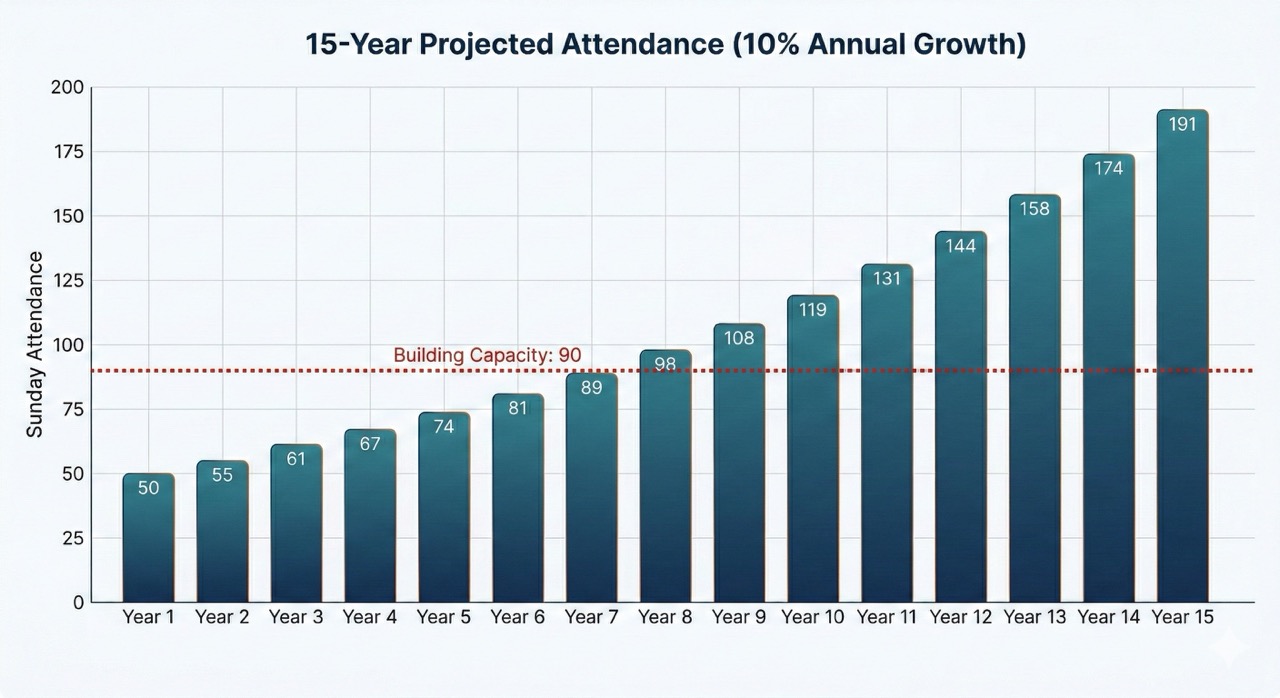 In my experience, this is exactly what church growth looked like for our church, until we hit around 90. Then we hit the limits of our church building which stopped our growth. (That's a topic for another post.)
Here is why I like this exercise:
- It gives us an attainable goal.
No matter how small your church is, 10% feels like it is something that you can do. You can grow from 50 to 55 with just one new family. Around a certain point, it becomes a little easier to gain new families, as people are attracted to a bigger crowd and what it brings.
Those early years are tough, and you need to have a realistic way of measuring success. Stick with it and you'll get through it. Tracking your attendance over time helps you put those losses in a longer term perspective.
No matter your size, 10% doesn't feel like that much. In fact, you could probably lose 10% of your regular attendees and most people wouldn't even notice.
- It doesn't overwhelm the church.
If you have a church of 50 and you suddenly get 25 new members, the sad fact is that people in that original 50 are going to feel overwhelmed and may even revolt. But if you grow by 4, most of the church will miss that it even happened.
Growing too fast can cause all kinds of strain to a church. It can overwhelm your buildings, cause strains in relationships, and shock your church culture. In contrast, a slow annual growth rate is natural and gives the church plenty of time to prepare.
And that leads me to the third benefit of slow church growth:
- It gives us a way to plan for future growth ahead of time.
If we had had the foresight at Bible Baptist to look ahead and say "we've been growing at 10% for the last three years, what does the next ten years look like at that growth rate?" We would have been able to foresee that we were going to run out of room and we could have planned accordingly.
A 10% growth model gives your church a tool to model the future and plan accordingly. You can say things like "If we keep growing at this rate, will we have enough parking in five years?"
Conclusion (and shameless plug)
It's really hard to measure growth if you aren't measuring your attendance. Knowing who is there and who is not week in and out doesn't just help you better pastor your church and care for your flock, it helps you see patterns over time. It can also help you put seasonal dips in a long term perspective. Congregation Hub provides a free platform for this that works with churches of any size (but is especially built for churches under 200). Sign up today and start tracking your attendance and much more.